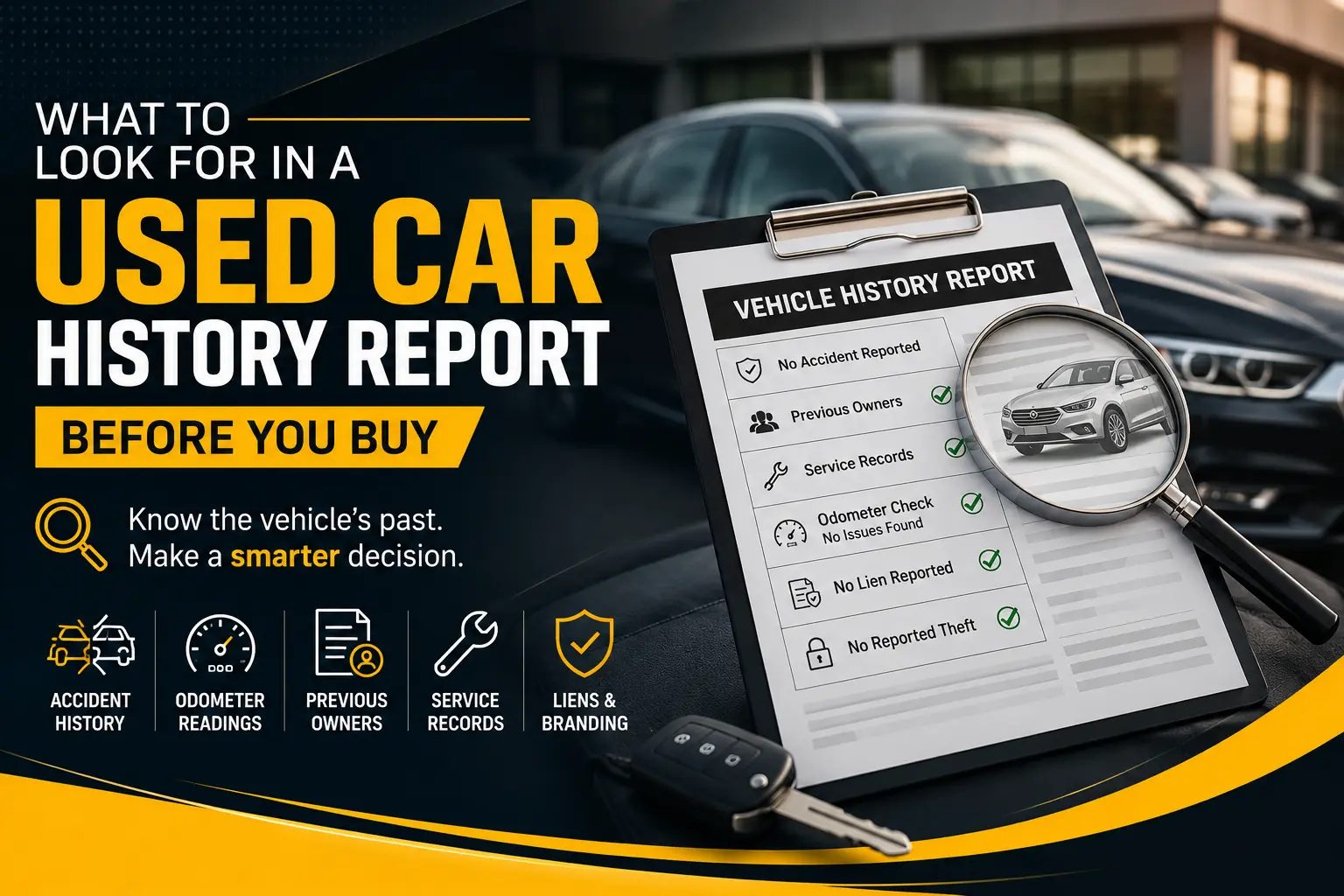
Buying a used car is about more than checking the price, mileage, and appearance.
A vehicle can look great in photos, drive well on a short test drive, and still have important history you should know about before buying it. That is why a used car history report is an important part of the buying process.
A vehicle history report can help you learn about reported accidents, damage, registration history, service records, recalls, odometer readings, and other information connected to a vehicle. In Canada, CARFAX Canada says its reports use data from thousands of sources across North America.
But there is an important point many buyers miss: A vehicle history report is not a replacement for a proper inspection and test drive.
Here is what you should actually look for when reviewing one.
What Is a Vehicle History Report?
A vehicle history report is a record of information collected about a specific vehicle using its VIN. The report can provide information about the vehicle's past, such as:
-
Accident and damage history
-
Previous registration
-
Number of previous owners
-
Odometer readings
-
Service records
-
Recall information
-
Theft information
-
Vehicle branding
-
Rebuild or salvage history
-
U.S. history
-
Liens, when a lien check is included
The exact information available depends on the vehicle and the records reported to the provider. This makes a history report useful before you spend money on a used vehicle.
1. Check the Accident and Damage History
One of the first things to check is whether the vehicle has a reported accident or damage history. Don't stop at seeing the words "accident reported." Look at the details available. You may want to find out:
-
When did the damage happen?
-
Where was the vehicle damaged?
-
How serious was the damage?
-
Was an insurance claim reported?
-
Was there a repair estimate?
-
Was structural or frame damage reported?
-
Was the vehicle repaired afterward?
CARFAX Canada reports that its vehicle history reports can include accident history, damage location, repair estimates, and structural damage information when those records are available.
A reported accident does not automatically mean a vehicle is a bad purchase. The important question is what happened and how the vehicle was repaired.
2. Look at the Registration History
Registration history can tell you more about where and how the vehicle was previously registered.
Look for information about:
-
Previous provinces
-
Registration status
-
Vehicle branding
-
Previous use
-
Number of previous owners
This can help you understand the vehicle's background.
For example, a vehicle that has moved between provinces may have a different history from one that has spent most of its life in the same area.
CARFAX Canada says its reports can include past and present registration information, previous use, branding, and the number of previous owners.
3. Check the Odometer History
Mileage is one of the easiest things for a buyer to look at, but the history of the mileage is more important than the number displayed on the dashboard.
Compare the mileage entries in the report.
You want to see a reasonable progression over time.
For example:
2019: 52,000 km
2020: 67,000 km
2022: 91,000 km
2024: 118,000 km
That makes sense.
But if you see:
2022: 110,000 km
2023: 82,000 km
that deserves further investigation.
A mileage inconsistency does not automatically prove fraud. There could be an error or another explanation. But it is something you should ask about before buying.
CARFAX Canada lists odometer readings among the information that may appear in a vehicle history report.
4. Review the Service History
A vehicle history report may include service records if they have been reported to the provider.
Look for maintenance such as:
-
Oil changes
-
Brake work
-
Tire rotations
-
Major repairs
-
Other recorded maintenance
A consistent service history can give you a better idea of how the vehicle was maintained.
However, don't assume that missing service records mean the vehicle was never maintained. Not every repair or maintenance visit is necessarily reported to the history-report provider.
CARFAX Canada specifically notes that its reports are based on information supplied by participating data sources, so some information may not be included.
That is why it is useful to ask whether additional maintenance records are available.
5. Check for a Lien
This is one of the most important checks that buyers should not overlook. A lien can mean money is still owing against the vehicle.
If you purchase a vehicle without properly dealing with an existing lien, you could potentially face problems connected to that debt.
Not every standard vehicle history report includes a lien search.
CARFAX Canada offers a Vehicle History Report + Lien Check that specifically searches for money owing on the vehicle. So when reviewing a report, check whether a lien search was actually included. Don't assume that every vehicle history report automatically includes one.
6. Look for Rebuilt, Salvage or Other Branding
Vehicle branding is another section worth paying close attention to.
Depending on the vehicle's history, you may see information related to branding such as:
-
Normal
-
Salvage
-
Rebuilt
-
Irreparable
The meaning and rules around vehicle branding can vary by province.
If you see a branding status you don't understand, stop and ask questions before buying.
Don't rely on the vehicle's appearance alone.
7. Check for Open Safety Recalls
A vehicle history report may also show information about safety recalls. An open recall does not necessarily mean you should immediately reject the vehicle.
Instead, find out:
What is the recall?
Has the repair been completed?
Can the repair be completed by the manufacturer or another authorized facility?
CARFAX Canada includes reported unfixed safety recalls among the information that may appear in its vehicle history reports.
8. Look at Theft and Import History
A vehicle history report can also contain information about theft and U.S. history.
This is particularly useful when you're trying to understand the vehicle's complete background.
CARFAX Canada's reports can include stolen status and U.S. history when information is available.
If something in the history doesn't match what you were told about the vehicle, ask for clarification before moving forward.
9. Make Sure the VIN Matches
This is a simple step, but don't skip it.
The vehicle history report is connected to the vehicle's VIN.
Before relying on the report, make sure the VIN on the report matches the VIN on the actual vehicle.
You can compare the VIN shown on the report with the VIN found on the vehicle.
If they don't match, stop the buying process and investigate before doing anything else.
A history report for the wrong VIN isn't useful.
10. Don't Assume a "Clean" Report Means a Perfect Car
This may be the most important point in the entire article. A clean vehicle history report is a positive sign, but it is not a guarantee that the vehicle has never had a problem.
Why?
Because history reports depend on information being reported to the provider.
CARFAX Canada itself states that there may be information about a vehicle that has not been reported to it.
That means a buyer should use the history report as one part of the buying process, not the entire process.
What a Vehicle History Report Can't Tell You
A history report is useful, but there are things it cannot replace. It generally cannot tell you everything about the vehicle's current mechanical condition.
For example, a report may not tell you that:
-
The brakes are nearly worn out
-
A suspension component is failing
-
The engine has a current mechanical problem
-
The tires are near the end of their life
-
The vehicle has a new fluid leak
-
A warning light will appear tomorrow
-
The vehicle doesn't feel right during a test drive
That's why a vehicle history report, inspection, and test drive should work together. CARFAX Canada itself recommends using its report along with a vehicle inspection and test drive.
Vehicle History Report vs. Vehicle Inspection
These two checks do different jobs.
|
Vehicle History Report |
Vehicle Inspection |
|
Looks at recorded history |
Looks at current condition |
|
Accident records |
Mechanical condition |
|
Registration history |
Brakes and suspension |
|
Odometer records |
Tires |
|
Service records |
Engine and transmission condition |
|
Theft information |
Leaks and visible problems |
|
Recall information |
Road-test behaviour |
|
Branding information |
Current vehicle condition |
You want both.
The report helps answer:
"What happened to this vehicle before?"
An inspection helps answer:
"What condition is this vehicle in now?"
7 Questions to Ask After Reading a Used Car History Report
If something in the report catches your attention, don't be afraid to ask questions.
Here are seven useful ones:
1. Has this vehicle ever been in an accident?
If yes, ask what happened and what repairs were completed.
2. Can I see the available service records?
These can help confirm how the vehicle was maintained.
3. Does the mileage history make sense?
Look for any unexplained gaps or changes.
4. Does the vehicle have any branding?
Ask what the branding means and why it was assigned.
5. Has the vehicle ever been registered outside Saskatchewan?
If so, ask about its previous history.
6. Is there a lien check?
Don't assume a standard history report includes one.
7. Can I inspect and test-drive the vehicle?
A history report should be followed by a proper evaluation of the vehicle.
A Simple Used Car History Report Checklist
Before buying a used vehicle, save this checklist:
☐ Confirm the VIN
☐ Review accident history
☐ Check damage details
☐ Review registration history
☐ Check vehicle branding
☐ Review odometer readings
☐ Check available service records
☐ Look for open recalls
☐ Check theft history
☐ Check U.S./import history
☐ Confirm whether a lien check was completed
☐ Compare the report with the actual vehicle
☐ Take the vehicle for a test drive
☐ Have the vehicle properly inspected
Buying a Used Car in Saskatoon?
A vehicle history report is one of the best tools you can use when researching a used vehicle, but it should be only one part of your decision.
At OVI Motors, you don't have to worry about uncovering the vehicle's history on your own. Where applicable, we provide a vehicle history report so you can understand the vehicle's recorded history, ask the right questions, and shop with greater peace of mind.
You can also review OVI Motors' current used vehicle inventory to see available cars, SUVs and trucks.
Found a vehicle you like? Review its history, inspect it, take it for a test drive, and ask questions before making your decision.
Ready to start shopping? Contact Ovimotors
📞 Phone: (306) 717-8105
📧 Email: sales@ovimotors.ca
📍 Address: Dudley Street, Saskatoon, SK S7M 3Z7
🧾book a test drive
FAQ
Is a vehicle history report worth it when buying a used car?
Yes. It can provide useful information about a vehicle's reported history, including accidents, registration, mileage, service records, and other events. However, it should be used together with an inspection and test drive.
What does a used car history report show?
Depending on the report and available records, it can show accident and damage history, registration information, odometer readings, service records, recalls, theft information, vehicle branding, and other details.
Does a clean vehicle history report mean the car has never been damaged?
No. A history report only contains information available from its data sources. Some incidents may not have been reported.
Does a CARFAX Canada report include liens?
A standard Vehicle History Report does not necessarily include a lien search. CARFAX Canada offers a separate Vehicle History Report + Lien Check.
Should I inspect a used car if it has a clean history report?
Yes. A history report cannot replace a mechanical inspection or test drive.
What should I do if the VIN on the report doesn't match the vehicle?
Stop and investigate before continuing with the purchase. The history report must correspond to the actual vehicle you're considering.
Comments (0)
Leave a Comment
No comments yet. Be the first to comment!