
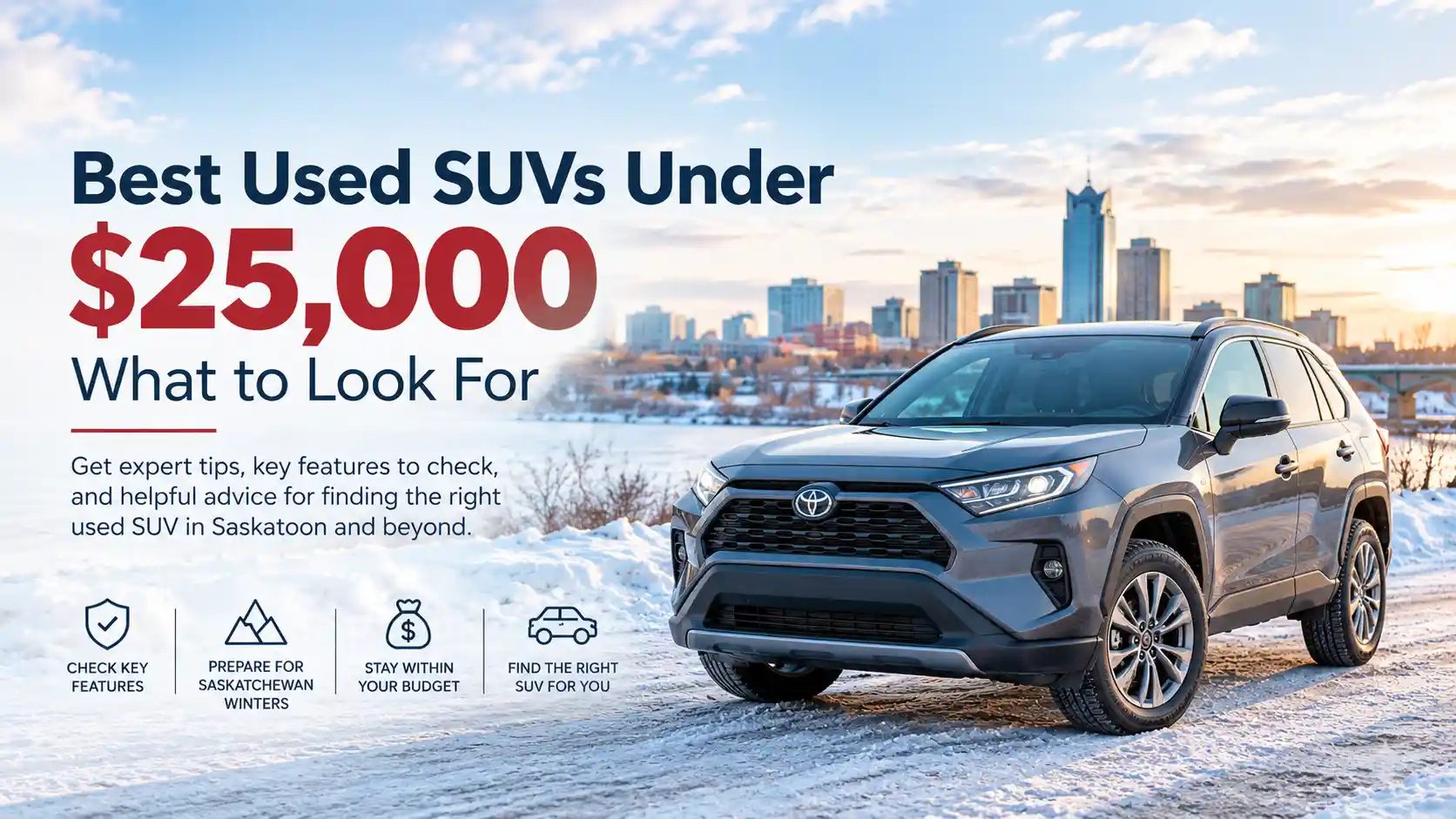
If you're shopping for used SUVs under $25,000, you have plenty of options to consider. The challenge is finding a vehicle that gives you the right balance of price, reliability, fuel economy, space, and features.
For buyers in Saskatoon and across Saskatchewan, there are a few additional things worth considering. Winter driving, road conditions, rust, tires, and drivetrain can all affect which used SUV makes sense for you.
The best choice isn't necessarily the newest SUV or the one with the lowest kilometres. It's the one that fits your budget and has a good combination of condition, maintenance history, features, and overall value.
What Can You Expect From a Used SUV Under $25,000?
The selection of used SUVs under $25,000 can vary depending on the model year, mileage, condition, and current market.
At this price point, you may find:
-
Compact SUVs
-
Older midsize SUVs
-
Front-wheel-drive models
-
AWD SUVs
-
Family-friendly vehicles
-
Fuel-efficient crossover SUVs
-
Vehicles with modern safety and convenience features
You may also have to choose between age, mileage, features, and drivetrain.
For example, spending the same amount on two different SUVs could give you a newer vehicle with more kilometres or an older vehicle with fewer kilometres. Neither is automatically the better choice.
That's why it's important to look beyond the price tag.
5 Things to Check Before Buying a Used SUV
1. Check the Mileage and Maintenance History
Mileage is one of the first things most buyers look at, but it shouldn't be the only factor.
A vehicle with higher kilometres can still be a good purchase if it has been properly maintained. Look for evidence of regular oil changes, brake work, tire replacement, fluid servicing, and other scheduled maintenance.
Ask for maintenance records when they are available and check the vehicle history before making a decision.
2. Decide Between AWD and FWD
If you're shopping for a used SUV in Saskatchewan, you may be considering AWD.
All-wheel drive can provide additional traction when accelerating on slippery roads, which can be useful during winter driving. However, AWD doesn't eliminate the need for proper winter tires or careful driving.
Front-wheel-drive SUVs can also be practical for many drivers and may offer good fuel economy and lower purchase costs.
Think about where and how you drive before paying extra for AWD.
3. Look at Fuel Economy
SUVs generally offer more space than many sedans, but fuel costs can vary significantly between models.
Before buying, consider:
-
Your daily driving distance
-
City vs highway driving
-
Engine size
-
AWD vs FWD
-
Your expected annual kilometres
-
Fuel prices
-
Your overall budget
A slightly more fuel-efficient SUV may save you money over several years of ownership.
4. Check Safety and Comfort Features
A used SUV doesn't have to be brand new to offer useful features.
Depending on the model and year, you may find:
-
Backup cameras
-
Blind-spot monitoring
-
Heated seats
-
Apple CarPlay or Android Auto
-
Adaptive cruise control
-
Lane departure warning
-
Automatic emergency braking
-
Remote start
-
Heated steering wheels
Make a list of the features that actually matter to you before you start shopping. This can make it easier to compare different vehicles.
5. Inspect the Vehicle's Condition
A clean exterior doesn't necessarily mean the vehicle is mechanically sound.
Before buying, inspect:
-
Tires
-
Brakes
-
Suspension
-
Engine compartment
-
Fluid levels and leaks
-
Lights
-
Windshield
-
Interior electronics
-
Undercarriage
-
Signs of rust or previous damage
A professional inspection can also help identify problems that aren't obvious during a normal walk-around.
Used SUVs for Saskatchewan: What Should You Look For?
Saskatchewan's driving conditions can be harder on vehicles than mild-weather environments.
Snow, ice, cold temperatures, road salt, and rough winter conditions make certain areas particularly important when shopping for a used SUV.
Winter Tires
Winter tires should be high on your checklist.
AWD can help with traction when accelerating, but it doesn't provide the same benefit as having tires designed for cold temperatures and winter road conditions.
Check the tire condition and ask about the age of the tires before purchasing.
Rust and Corrosion
Check carefully for rust, especially underneath the vehicle and around areas such as:
-
Wheel arches
-
Rocker panels
-
Door edges
-
Underbody
-
Suspension components
Some surface rust may be manageable, while serious corrosion can become an expensive problem.
Battery and Heating
Cold Saskatchewan winters can put additional demands on a vehicle's battery and heating system.
During a test drive, make sure the heater and defroster work properly. Also check that the vehicle starts normally and that there are no warning lights on the dashboard.
Brakes and Suspension
Winter roads, potholes, and rough driving conditions can contribute to wear.
Listen for unusual suspension noises during your test drive and pay attention to how the vehicle brakes and handles.
AWD vs FWD: Which Is Better for a Used SUV?
There's no single answer for every driver.
AWD may make sense if you:
-
Frequently drive on snow-covered roads
-
Travel outside the city
-
Drive on rural roads
-
Want additional traction when accelerating
-
Regularly deal with changing winter conditions
FWD may make sense if you:
-
Mostly drive in the city
-
Want to keep the purchase price lower
-
Prioritize fuel economy
-
Don't regularly need additional drivetrain capability
Most importantly, AWD should not be treated as a substitute for winter tires.
When comparing two SUVs, look at the complete package rather than choosing based on AWD alone.
What Are Some Popular Used SUVs to Consider?
The used SUV market includes models from many manufacturers, and the right choice depends on your budget and requirements.
Some brands worth comparing include:
-
Toyota
-
Honda
-
Nissan
-
Hyundai
-
Kia
-
Mazda
-
Subaru
-
Ford
-
Chevrolet
-
Mitsubishi
For example, compact SUVs such as the Kia Seltos can appeal to buyers looking for a smaller SUV with practical interior space and available AWD. Larger options such as the Hyundai Santa Fe may make more sense for buyers who need additional passenger or cargo space.
Models and availability change regularly, so it's better to compare vehicles based on their current condition, mileage, history, features, and price rather than choosing a model simply because it appears on a list.
Should You Buy a Used SUV With Higher Mileage to Stay Under $25,000?
It can be a reasonable option.
If your budget is fixed, accepting a vehicle with more kilometres may allow you to consider a newer model or a better-equipped SUV.
But don't compromise on the basics.
Before buying a higher-mileage SUV, check:
-
Maintenance history
-
Vehicle history report
-
Engine condition
-
Transmission
-
Brakes
-
Suspension
-
Tires
-
Rust
-
Previous accidents
-
Upcoming maintenance requirements
A well-maintained SUV with higher mileage can be a better purchase than a lower-mileage vehicle that has been neglected.
How Much Should You Spend on a Used SUV?
A $25,000 budget doesn't mean you have to spend exactly $25,000.
Remember to account for the total cost of ownership, including:
-
Taxes and registration
-
Insurance
-
Fuel
-
Maintenance
-
Tires
-
Repairs
-
Financing costs, if applicable
It can be useful to leave some room in your budget for immediate maintenance or other ownership costs.
Also, compare the out-the-door cost rather than looking only at the advertised vehicle price.
How to Find the Right Used SUV in Saskatoon
Once you've narrowed down your budget and preferred vehicle type, compare several options before making a decision.
A good starting process is:
1. Set your budget.
Know how much you can comfortably spend.
2. Choose the size you need.
A compact SUV may be enough for commuting, while families may prefer a larger model.
3. Decide whether you need AWD.
Consider your normal driving conditions rather than assuming you need it.
4. Compare mileage and maintenance.
Look at the complete history, not just the odometer.
5. Check the vehicle history.
Look for reported accidents, damage, and other available information.
6. Take a test drive.
Pay attention to braking, steering, transmission, suspension, and unusual sounds.
7. Consider an inspection.
An independent inspection can provide additional confidence before you purchase.
8. Compare the overall value.
Price is important, but condition and ownership costs matter too.
If you're shopping for used SUVs in Saskatoon, OVI Motors regularly updates its pre-owned inventory with SUVs and other vehicles. You can compare available vehicles based on your budget, preferred features, mileage, and driving needs.
Is a Used SUV Under $25,000 Right for You?
A used SUV can be a practical choice if you want more cargo space and seating flexibility without paying the price of a new vehicle.
But don't choose based on the $25,000 price point alone.
Look at the vehicle's condition, history, maintenance, mileage, drivetrain, fuel economy, and expected ownership costs. For Saskatchewan buyers, also pay close attention to tires, rust, brakes, heating, and winter-related wear.
The right used SUV is the one that fits your budget, your driving conditions, and your everyday needs.
Ready to Find Your Next SUV?
Looking for used SUVs under $25,000 in Saskatoon? Our team at OVI Motors can help you find the right vehicle based on your budget and needs.
Browse Our SUV Inventory Today.
Contact OVI Motors today:
📞 Call:(306) 717-8105
📧 Email:sales@ovimotors.ca
📍 Visit: Saskatoon, Saskatchewan
Frequently Asked Questions
Are there good used SUVs under $25,000?
Yes. The options available will depend on the current used vehicle market, but buyers can find compact and midsize SUVs in this price range. Always compare condition, mileage, maintenance history, features, and overall value.
Is $25,000 enough for a good used SUV in Canada?
It can be. Your options will depend on the model, year, mileage, condition, and local market. Setting a realistic budget and comparing several vehicles can help you find better value.
Should I buy an AWD SUV for Saskatchewan winters?
AWD can provide additional traction when accelerating on slippery surfaces, but it isn't essential for every driver. Winter tires, careful driving, vehicle condition, and your normal routes should also be considered.
What should I check when buying a used SUV?
Check the vehicle history, maintenance records, mileage, tires, brakes, suspension, engine, transmission, rust, interior features, and warning lights. A professional inspection can provide additional peace of mind.
Are used SUVs expensive to maintain?
Maintenance costs vary significantly between models. Age, mileage, previous maintenance, engine type, drivetrain, and replacement-part costs can all affect ownership expenses.
Is a higher-mileage SUV worth buying?
It can be. A higher-mileage SUV with a strong maintenance history and good overall condition may offer better value than a lower-mileage vehicle that has been poorly maintained.
Comments (0)
Leave a Comment
No comments yet. Be the first to comment!